Does GHK-Cu increase collagen?
The cell-culture finding is specific and persuasive within its setting. The detail about cell number deserves as much attention as the increase in collagen.
Fibroblast cultures, 1988
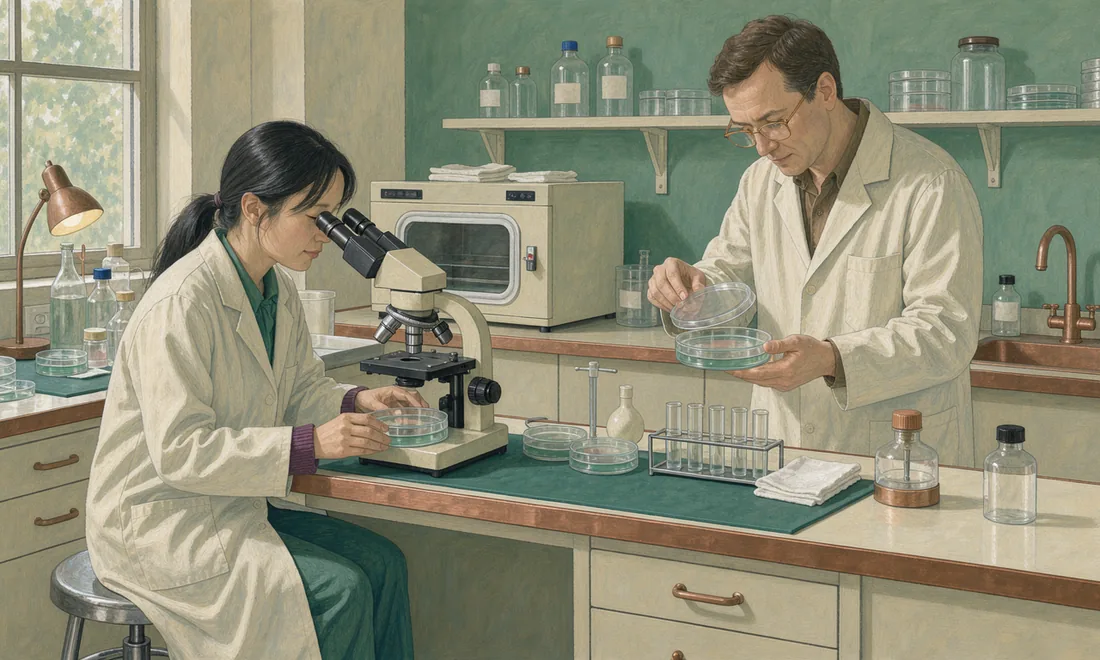
The collagen-synthesis study published in 1988 exposed human fibroblast cultures to GHK-Cu and found increased collagen synthesis. Fibroblasts are the cells being asked to produce collagen in this experiment. The copper-peptide complex was added to the culture medium, so the result concerns cells with direct access to the studied material.
I enjoy the proportions of that contained setup. A defined material meets a defined experimental system, and the investigators measure a particular response. There is plenty to be curious about without supplying a whole story about somebody's face.
The same paper reports that the stimulation was observed without any change in cell number. That qualification sharpens the finding: the increase in collagen production was observed without an accompanying increase in the number of cells. It gives the result a different character from a culture simply containing more cells capable of making collagen.
The cell-number finding
My enthusiasm centres on the separation of collagen synthesis from cell proliferation. Proliferation means an increase in cell number. The reported result lets collagen production stand on its own as an observation, rather than leaving the reader to guess whether a larger culture explains it.
That does not answer every question I have about collagen in skin. It does make this a cleaner starting point for the argument. I would rate an accurately described cell result above a sweeping claim with its experimental setting rubbed away.
There is also a useful change of scale here. A person looking at skin sees an overall appearance. The experiment measures a biological process. Connecting those views calls for more work than replacing the phrase collagen synthesis with the word firmness. The skin-regeneration review discusses both cell biology and topical clinical findings; I read those as related pieces of the subject, each with its own job.
Tissue remodelling
The tissue-remodelling review describes a broader pattern involving collagen, elastin, matrix-regulating enzymes and repair-cell recruitment across human and animal studies. That broader picture is where the subject comes alive for me. The interesting research question is how tissue is being rebuilt and organised.
This is a review bringing together different systems and routes of administration. Its breadth is useful for generating questions; a particular visible skin outcome still needs its particular clinical evidence. I am comfortable being impressed by the reach of the biology while asking for precision about where each observation came from.
My preferred next comparison would join a clearly described topical formulation to both a tissue measurement and a visible skin outcome in the same human study. That is an editorial wish, not a claim that the culture result already supplies the answer. The skin-barrier essay explains the physical complication that sits between these views.