How GHK crosses the skin
A peptide can be biologically interesting and physically difficult to deliver. The measurements become clearer once the material and the skin preparation are in view.
The outer layer
The barrier is where the copper-peptide story acquires some friction. The topical GHK review identifies poor stratum-corneum permeability as a central delivery challenge. The admission earns my respect. Skin delivery is an actual constraint on the proposed effect, and it deserves a place near the beginning of the discussion.
The review considers changes to the peptide and changes to the way it is delivered. Those alternatives are interesting because they alter the experiment itself. Evidence about a modified form or pretreated skin answers a question about that modified form or that preparation.
My first impulse was to treat delivery as a technical detail to leave until later. I now regard it as part of the main question. If the claim concerns a topical effect, then the way a material encounters the skin belongs in the account of that effect. The collagen experiment is much easier to interpret once its direct exposure of cells is set beside the physical problem described here.
Copper measured in prepared human skin
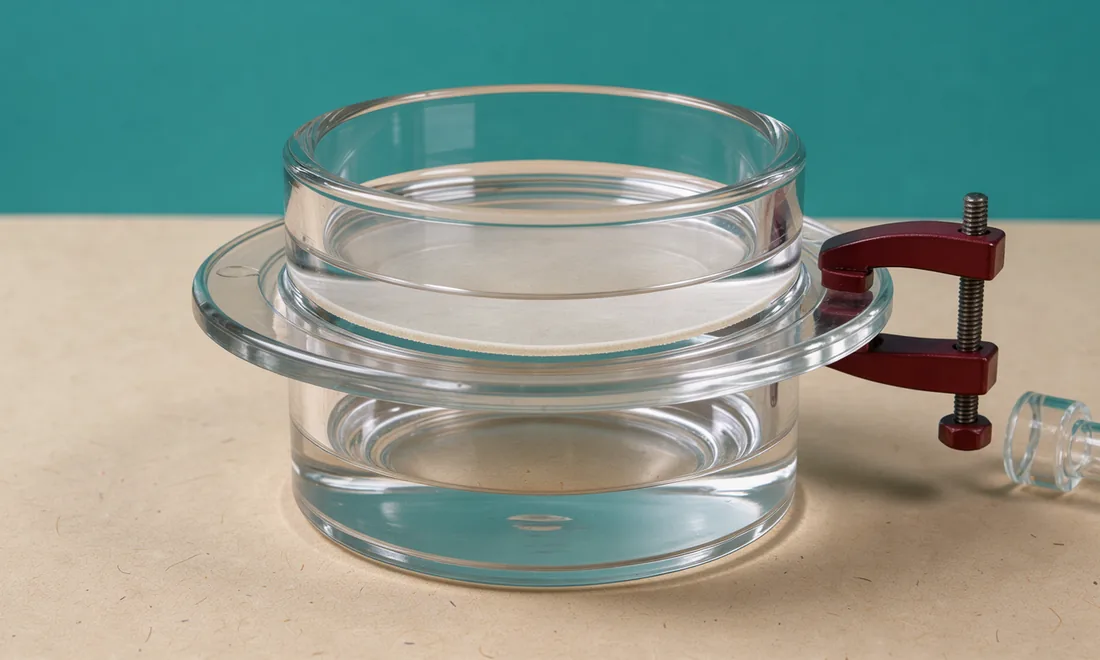
In the human-skin penetration study, copper applied as a GHK-Cu tripeptide preparation was measured across different skin layers in laboratory conditions. The study used human skin outside the body. Dermatomed skin is skin prepared as a slice; that preparation stays attached to the meaning of the reported result.
Over 48 hours, the investigators reported 136.2 +/- 17.5 ug/cm^2 of copper permeating and 97 +/- 6.6 ug/cm^2 retained as a dermal depot. The measurements concern copper, and the study setting is ex vivo or in vitro human skin. Those are the boundaries within which I consider the finding informative.
The distinction between what passed through and what remained is especially useful. It replaces the vague idea of absorption with separate observations. I resist turning retained copper into a claim about a particular duration of visible benefit: the penetration experiment measures delivery and retention, while a cosmetic outcome requires its own evidence.
Changes to the peptide and to the barrier
The delivery strategies examined in the review include palmitoylation, which produces Pal-GHK, and microneedle pretreatment. They make different changes. One alters the studied material; the other alters the barrier it meets. The shared letters GHK tempt a quick equivalence that I distrust.
The review reports about 134 nmol of GHK permeating after microneedle pretreatment, versus none through intact skin in the comparison it discusses. That belongs to the reported experimental comparison. It supplies no instruction for a home procedure, and I draw no safety conclusion from the penetration number.
Set beside the prepared-skin copper study, this finding initially looks awkward: delivery was measurable in one account and absent through intact skin in the other. The accounts involve different preparations and measurements. My curiosity sharpens at the apparent mismatch. Before calling the findings contradictory, the comparison has to match what was applied, what was done to the skin and what the investigators measured.
The wrinkle evidence returns to the surface that started the question. A route through skin is an important piece of the argument; a visible cosmetic effect remains a separate outcome to examine.